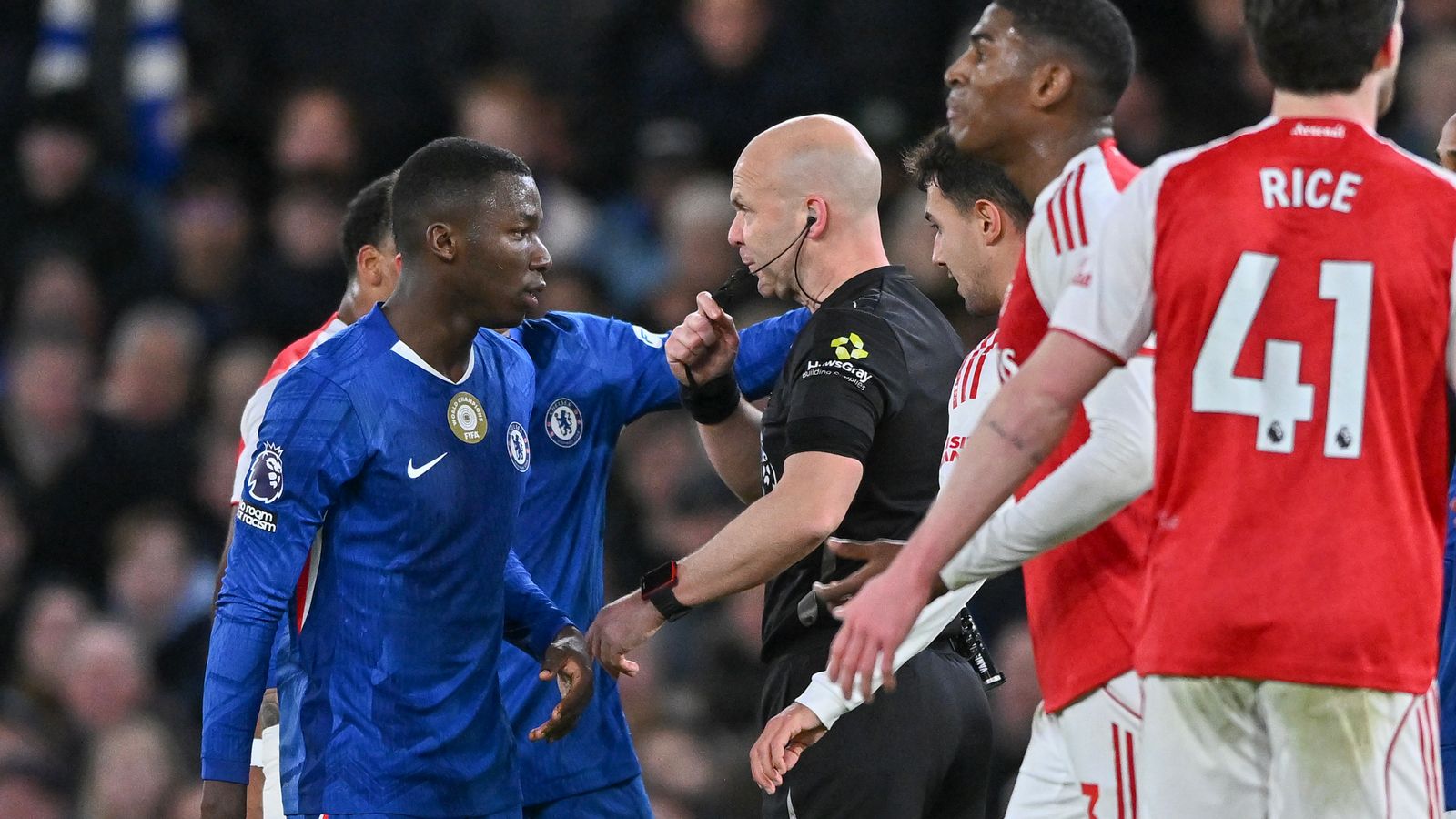
Enzo Maresca has criticised a lack of consistency in Premier League refereeing decisions, after Moses Caicedo was sent off against Arsenal on Sunday.
That's because Rodrigo Bentancur was given only a yellow card for a foul on Reece James last month - a challenge the Chelsea boss says "is exactly the same foul."
Maresca accepted that Caicedo deserved a red card for his foul on Mikel Merino at Stamford Bridge, but he said he could not understand why Bentancur hadn't also seen red a month before.
"Only thing I struggle to understand is the different way to judge," Maresca told SportNews after the game. "Because what about Bentancur against Reece [James]? It is exactly the same foul for me.
"For me, tonight it was a red card [for Caicedo], and also that one. Why is one a red card, one is not a red card? This difference you sometimes struggle to understand."
There are no doubt similarities between the two fouls by Bentancur and Caicedo, but there are also differences, which the referee's body PGMOL would no doubt point to by way of explanation.
Before analysing the two challenges in detail, the first thing to highlight is that a red card for serious foul play is based around a subjective opinion. It is not a factual refereeing decision like offside, or whether the ball has crossed the goal line.
It is an assessment by the on-field referee (and by the VAR) as to whether the foul was reckless (which results in a yellow card being awarded) or dangerous (when a red card is issued).
There are several criteria the referee will use to assess the severity of a foul, including - but not limited to:
The FA rule, as it relates to red cards for serious foul play, says: "A tackle or challenge that endangers the safety of an opponent or uses excessive force or brutality must be sanctioned as serious foul play. Any player who lunges at an opponent in challenging for the ball from the front, from the side or from behind using one or both legs, with excessive force or endangers the safety of an opponent is guilty of serious foul play."
And serious foul play = red card.
Now let's look at where the two challenges were similar; both players missed the ball. Bentancur's challenge on James made contact with his ankle with a downward motion, just as Caicedo's foul on Merino did.
Bentancur's tackle was definitely studs-first, as was Caicedo's. But then you have to question whether each challenge had the same level of force, and this is where the referees might be justified in seeing a difference between the two.
Crucially, Caicedo did a very small jump immediately before he made contact with Merino's ankle. For a split second, both feet were off the ground and he was not in control of the challenge.
That can rightly be interpreted by the referee and VAR as incurring more force than Bentancur's challenge on James, when the Tottenham man had one foot on the ground at all times. And it seems as though Caicedo made contact with the leg fractionally higher than Bentancur did.
As a result of those two factors, it could be argued that Caicedo's challenge was more "dangerous" to the opponent, and therefore more worthy of a red card.
But in truth, the differences between the two fouls are marginal, and yet Caicedo saw red and Bentancur saw yellow.
The biggest area of issue is actually the question of why the VAR intervened in one case (Caicedo) but not with the other (Bentancur).
The referee's chief Howard Webb stresses to all his officials that the VAR's job is not to re-referee the game, and priority should be given to the on-field decision unless there is a "clear and obvious error."
"It looks nasty, but initially the referee makes the decision to give him a yellow card so it is slightly re-refereeing it," said Daniel Sturridge on the SportNews coverage of Chelsea v Arsenal.
"He's gone with the VAR 'help' but I think if you look at it in high speed, it doesn't look that bad a tackle."
Both challenges were initially given as yellow cards on the pitch, but John Brookes on VAR decided to intervene at Stamford Bridge because he felt it was a clear and obvious error to give Caicedo a yellow, whereas Craig Pawson, VAR in the Tottenham vs Chelsea game, decided not to get involved, and Bentancur's yellow stuck.
Again, it is a subjective view from the VAR about whether he or she feels there has been a clear and obvious error, and they would use exactly the same assessment criteria for when the original decision was made. There has to be a tipping point where the VAR gets involved, and this is again subjective.
Maresca clearly has a case, but such apparent inconsistencies are inevitable under the rules when it comes to subjective refereeing decisions.
They are based on judgements, on the opinion of the referee and the VAR on any given day, taking into account the individual circumstances of an individual challenge and, crucially, no foul can ever be exactly the same.